

Italian · learn by reading
Learn Italian from texts you want to finish.
taihaa is a reading loop for Italian, alongside Mandarin, Cantonese, German, French, and Spanish. Bring an article, a story, or a class text. Tap a word for an English translation, save the useful ones with the sentence still attached, and review them later.
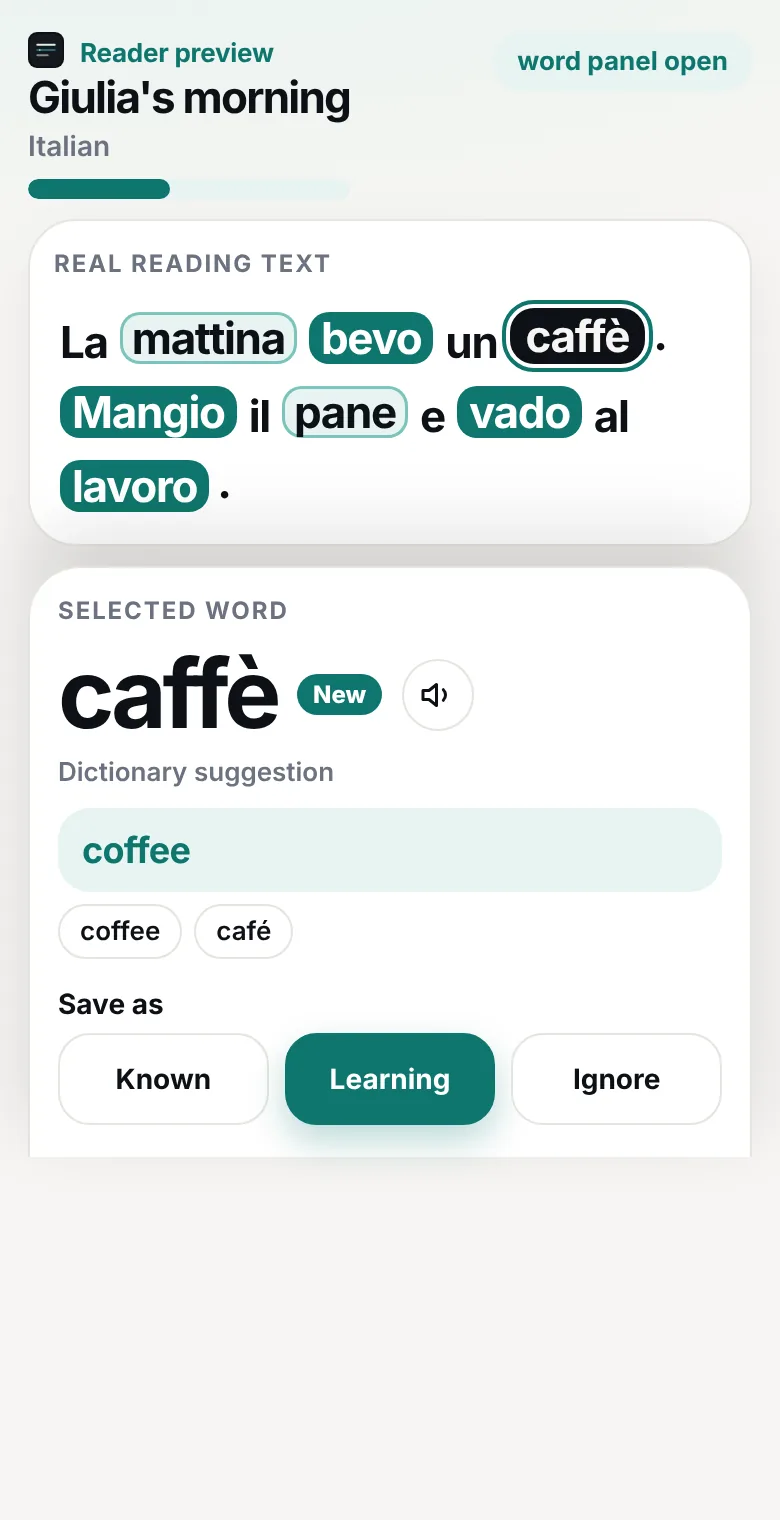
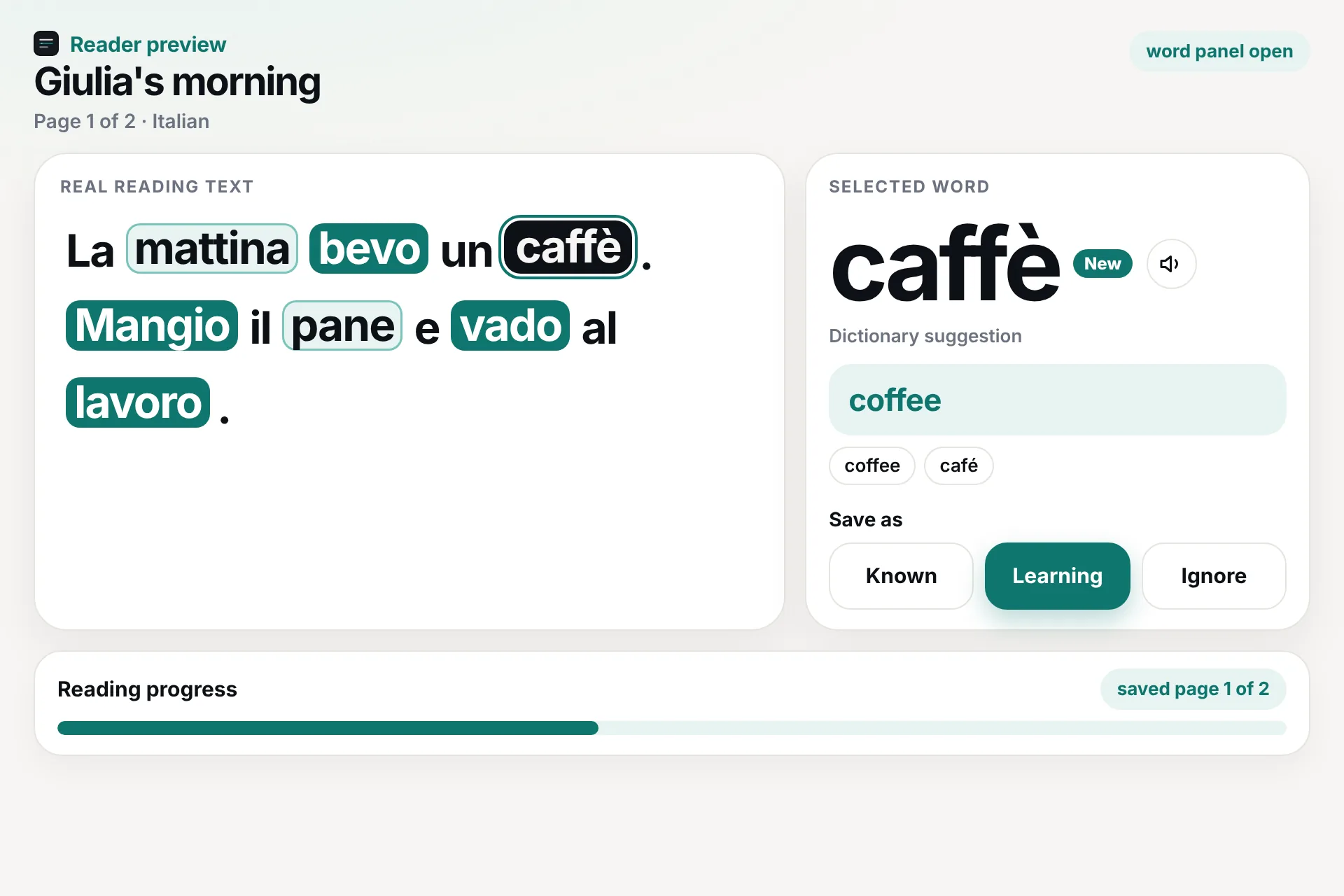
La mattina bevo un caffè.
In the morning I drink a coffee. Each of these is its own word. The accent in caffè stays on the word you tap.
La
the
mattina
morning
bevo
I drink
un
a
caffè
coffee
Reading, then a small review queue
Bring a text you can finish
A news paragraph, a class handout, a short story, or an EPUB chapter. A starter from the library works too. taihaa does not open on a stack of unrelated example sentences.
Tap the whole word
Italian uses the same Latin reader as German, French, and Spanish. Accents stay inside the word, so caffè and città are one tap. Elided articles such as l’ and un’ split off, so l’acqua looks up acqua.
Review the sentence
Saved words come back with the line they came from. Again, Learning, Known, and Easy set a simple spaced schedule. Ignore drops a word from review.
What Italian reading needs from a reader
A word list can introduce vocabulary. It cannot show you how mattina sits in a sentence you already care about. taihaa keeps the practice attached to a text: the reader for the first meeting, the saved sentence for the next ones.
Accents belong to the word
caffè, città, and papà stay one token. The reader does not split them into a base word plus a mark. A dictionary line can still match after case-folding, so Caffè and caffè look up the same headword.
Elisions split off
l’acqua, un’amica, and dell’ufficio start with a shortened article or preposition. The reader treats that piece like punctuation, so the word you tap is acqua, amica, or ufficio.
No conjugation table
bevo and beve are different shapes of a verb. taihaa does not turn the reader into a grammar chart. If a form has its own dictionary line, you will see a translation. If it does not, type the one that fits this sentence.
Level tags are estimates
Lessons can show an automatic CEFR tag, the same kind of estimate used for German, French, and Spanish. It helps you pick a text. It is not an exam result, and a short passage can be tagged with low confidence.
A practical first session
- Register and set the target language to Italian.
- Open a sample lesson, a library starter, or paste a short paragraph you already wanted to read.
- Read one page. Save three to eight words, and edit any translation that does not fit the sentence.
- Come back for review. The card should still show the sentence from that page.
URL import works best on public articles. If a page is paywalled or mostly scripts, paste the text instead. English is the base language for meanings. News in the library can pull public Italian feeds from ANSA, RaiNews, and Euronews.
Start with one Italian text.
You do not need a full course loaded in advance. One article is enough to see whether reading-first practice fits how you study.