

Features
A reader, a word list, and a review queue.
taihaa is for people who want to learn from a text they chose. Import it, look words up in place, save the useful ones, and review them with the sentence still attached.
Import
Start from a text you already have.
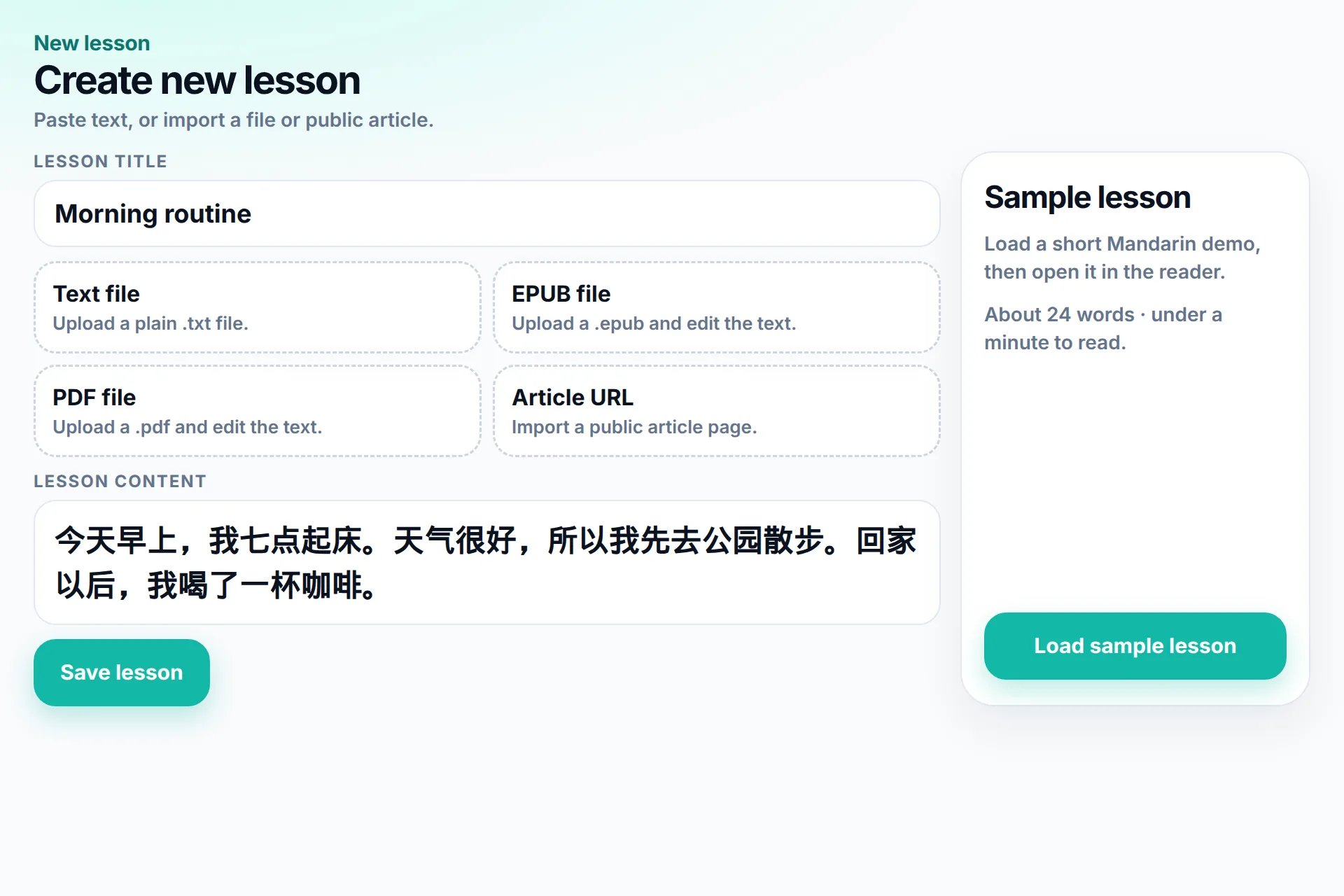
Paste a passage, upload a plain .txt, PDF, or EPUB, or import a public article URL. You can also load a short sample lesson or copy a starter from the library. Check imported text before you save it. Paywalled, login-only, or script-heavy pages often need a manual paste.
- Paste, .txt, PDF, and EPUB
- Public article URLs, when extraction works
- Sample lessons and a small library
Reader
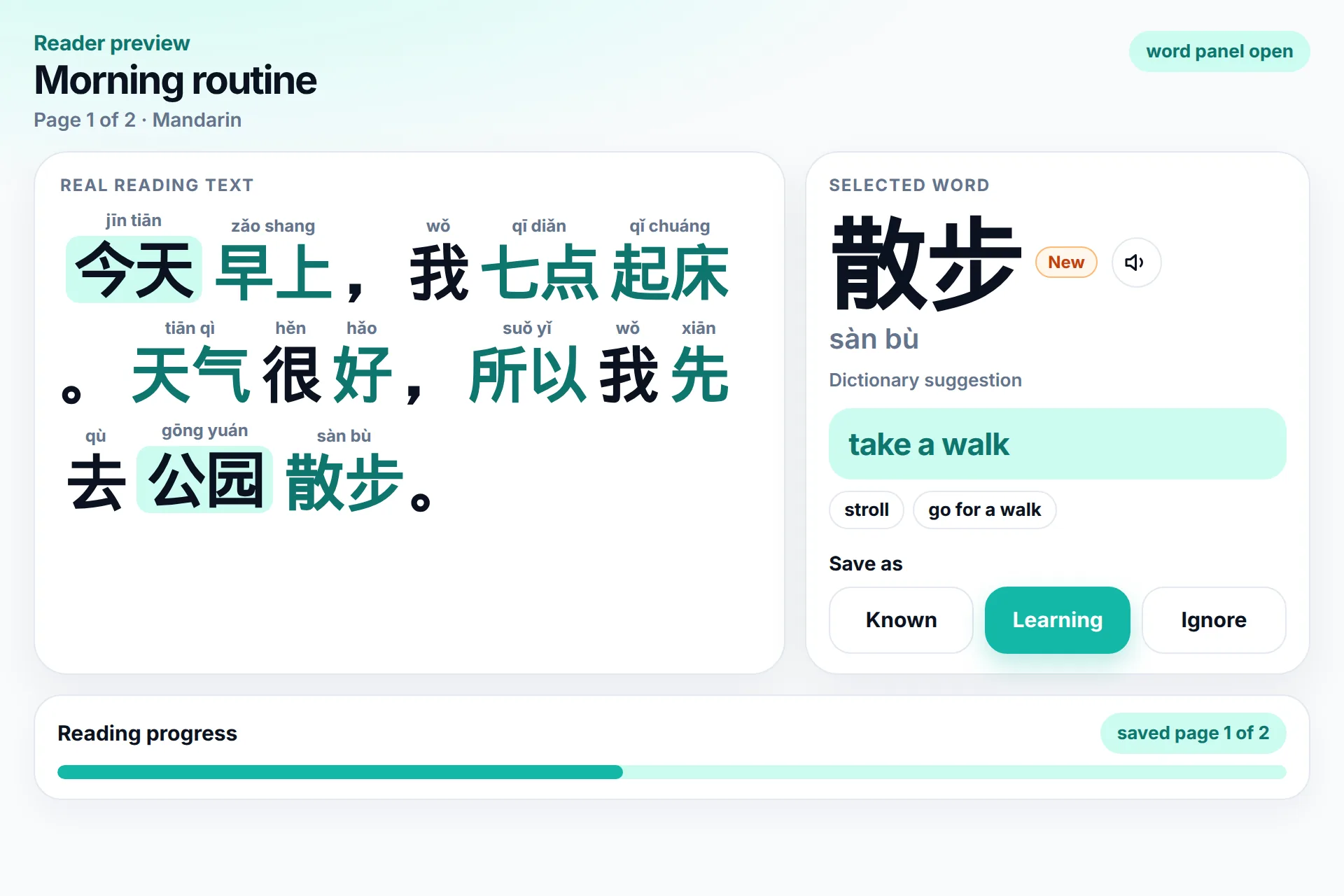
Tap a word without leaving the sentence.
The reader pages the lesson and keeps your place. Words you have not saved are marked so you can see what is still new. Tap one to open the word panel: a gloss suggestion, pinyin for Mandarin, or Jyutping for Cantonese. Your own saved vocabulary is preferred. Suggestions are aids. Edit a gloss before you save it if it looks wrong.
- Pinyin for Mandarin, Jyutping for Cantonese
- Dictionary suggestions you can edit
- Reading progress saved with the lesson
Vocabulary
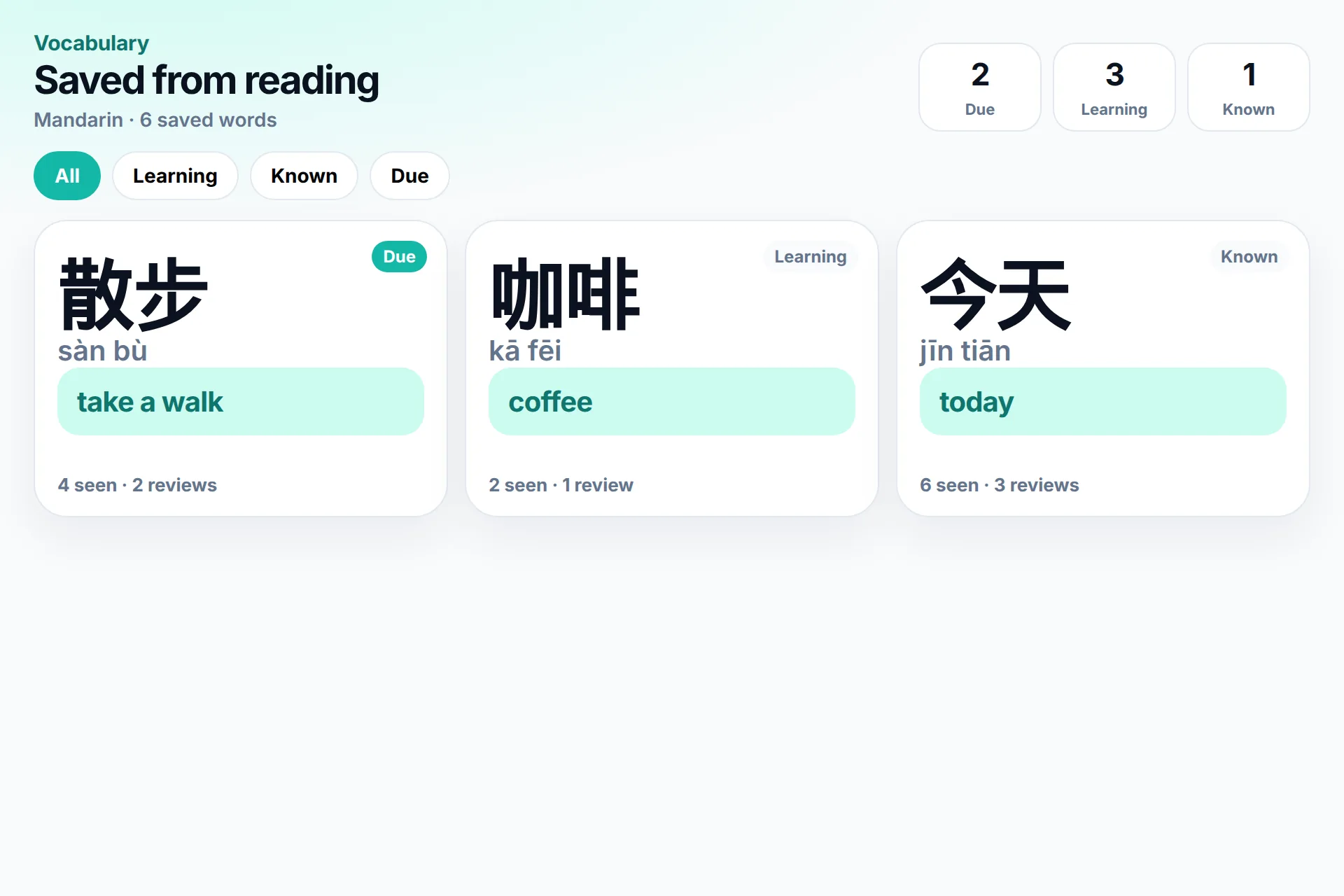
A list made from what you read.
Saved words keep an English gloss and the sentence they came from. Filter by status, see what is due, play a pronunciation when the device has a voice, and export the list. Empty glosses can be fixed before they show up cleanly in review.
- Known, Learning, and Ignore
- Due words called out separately
- Export from Vocabulary
Review
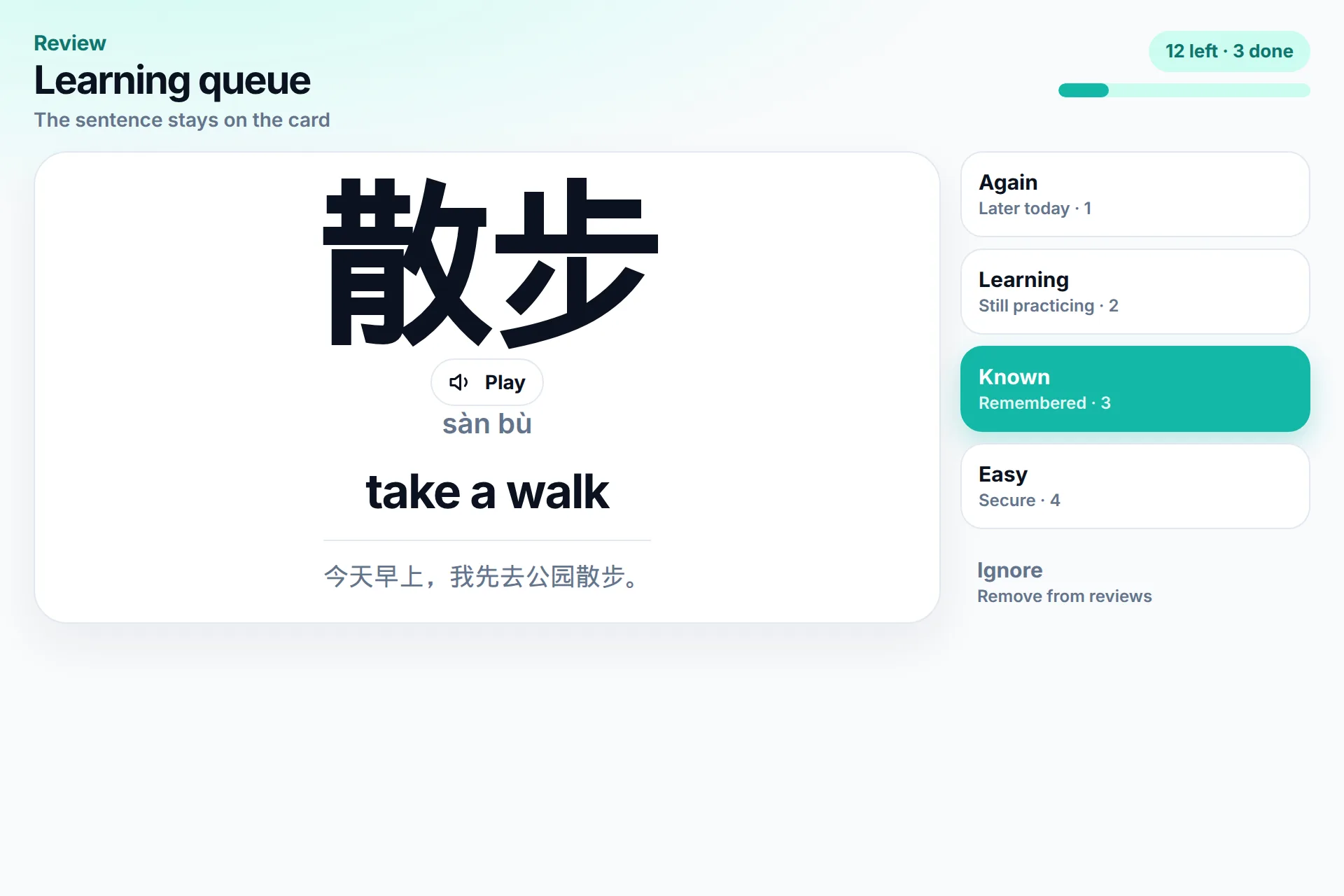
Meet the word again with the original line.
Review is a short spaced queue. Reveal the gloss, then grade the card. Again brings it back later today. Learning keeps a short interval. Known and Easy push it further out. Ignore removes it from review. The original sentence stays on the card so practice is not a bare word list.
- Again, Learning, Known, Easy, Ignore
- The source sentence stays attached
- Pinyin or Jyutping can stay visible in review
Speech
Hear a word when your device has a voice.
Text-to-speech uses the browser and the voices installed on the device. There is no separate paid voice service. If speech is unavailable, taihaa says so. For Cantonese, a real Cantonese or Hong Kong voice is required. A Mandarin voice is not used as a stand-in.
What the beta does not promise
- URL import fails on some sites. Paste the text when it does.
- Level tags, including CEFR and HSK estimates, are automatic guesses.
- Dictionary lines are suggestions, not a finished translation of the article.
- Jyutping and pinyin are reading aids, not a checked pronunciation for every line.
Four target languages. English glosses.
The public beta uses English as the base language for meanings. Pick one target language and stay in that reader, list, and review queue.
Mandarin
Simplified Chinese reading, pinyin, and dictionary suggestions. Lessons can show an estimated CEFR tag and an HSK 1–6 estimate. Those tags are guidance, not an exam result.
Cantonese
Kept separate from Mandarin. Jyutping uses tone numbers, and text-to-speech will not quietly fall back to a Mandarin voice.
German
Read articles and class texts, including long compounds, and review the words in the sentence where you met them.
French
Articles and stories become a personal list. English is the base language for the gloss you save.